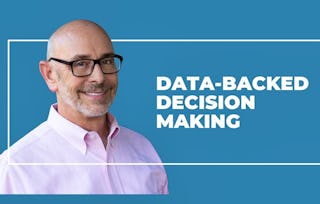
Based on the best-selling book, Becoming a Data Head, by Alex J. Gutman and Jordan Goldmeier. This course provides learners with the foundational skills to think critically about data and turn insights into actionable decisions. It covers key areas in data science, statistics, and machine learning, helping learners analyze data confidently and communicate findings effectively in diverse professional settings.
Data Science and Machine Learning for Business Professionals

Seize the savings! Get 40% off 3 months of Coursera Plus and full access to thousands of courses.

Data Science and Machine Learning for Business Professionals

Instructor: Wiley-Expert Edge Course Instructors
Included with
Recommended experience
What you'll learn
Evaluate machine learning techniques and their appropriate use cases
Challenge assumptions and identify biases in data and analysis
Communicate data insights effectively to non-technical stakeholders
Details to know

Add to your LinkedIn profile
March 2026
15 assignments
See how employees at top companies are mastering in-demand skills

There are 15 modules in this course
In this section, we learn to define business problems with clear objectives, identify affected stakeholders, and assess data readiness to ensure data projects deliver measurable value and avoid wasted resources.
What's included
2 videos3 readings1 assignment
In this section, we define data as encoded information, classify data types using standard terminology, and differentiate observational and experimental data collection methods, establishing a foundation for accurate analysis and informed decision-making.
What's included
1 video2 readings1 assignment
In this section, we develop statistical thinking by recognizing variation in data, applying skepticism to claims, and interpreting probabilities in context. These skills enable informed decision-making in business and everyday life.
What's included
1 video2 readings1 assignment
In this section, we learn to critically assess data quality by questioning its origin, collection methods, and representativeness. We evaluate validity, detect bias and missing data, ensuring reliable insights for informed decision-making.
What's included
1 video4 readings1 assignment
In this section, we explore exploratory data analysis (EDA) to uncover insights, identify outliers and missing values, and interpret correlations while avoiding causation errors, enabling data-driven decisions through iterative, evidence-based discovery.
What's included
1 video2 readings1 assignment
In this section, we explore probability notation, conditional reasoning, and common fallacies to enhance critical thinking about uncertainty. You will learn to interpret and challenge probabilistic claims in professional contexts with greater clarity and confidence.
What's included
1 video6 readings1 assignment
In this section, we examine statistical inference by evaluating sample size, significance levels, null hypotheses, and assumptions of causality. You'll learn to challenge data claims and make informed, evidence-based decisions.
What's included
1 video5 readings1 assignment
In this section, we explore unsupervised learning to discover hidden patterns in unlabeled data, applying PCA for dimensionality reduction and K-Means clustering to identify natural groupings with practical applications in customer segmentation and media organization.
What's included
1 video3 readings1 assignment
In this section, we explore linear regression as a foundational method for predicting numerical outcomes. We learn to implement least squares regression, evaluate performance using R-squared and residuals, and identify critical pitfalls like multicollinearity, omitted variables, and data leakage.
What's included
1 video4 readings1 assignment
In this section, we explore classification models for predicting categorical outcomes using logistic regression, decision trees, and ensemble methods. Key concepts include evaluating performance with confusion matrices and avoiding pitfalls like data leakage and misinterpreted accuracy.
What's included
1 video5 readings1 assignment
In this section, we transform unstructured text into numerical features using N-grams, word embeddings, and topic modeling. We apply Naïve Bayes for sentiment analysis, enabling actionable insights from customer feedback and textual data.
What's included
1 video6 readings1 assignment
In this section, we explore how artificial neural networks underpin deep learning, enabling complex tasks like image and language processing. We examine their structure, applications, and the ethical challenges of deploying opaque, black box models in real-world systems.
What's included
1 video6 readings1 assignment
In this section, we identify common data pitfalls such as survivorship bias, Simpson's Paradox, and algorithmic bias. You'll learn to apply proper train-test splits, detect regression to the mean, and avoid misleading conclusions in real-world data projects.
What's included
1 video3 readings1 assignment
In this section, we explore how interpersonal dynamics and communication breakdowns impact data projects. By identifying personality types, recognizing red flags, and applying empathy, teams improve collaboration and achieve better outcomes.
What's included
1 video1 reading1 assignment
In this section, we explore applying statistical thinking to real-world decisions, interpreting ML and AI results critically, and avoiding common data pitfalls. You'll gain the skills to drive informed, evidence-based change in complex environments.
What's included
1 video1 reading1 assignment
Instructor

Offered by
Why people choose Coursera for their career

Felipe M.

Jennifer J.

Larry W.

Chaitanya A.

Open new doors with Coursera Plus
Unlimited access to 10,000+ world-class courses, hands-on projects, and job-ready certificate programs - all included in your subscription
Advance your career with an online degree
Earn a degree from world-class universities - 100% online
Join over 3,400 global companies that choose Coursera for Business
Upskill your employees to excel in the digital economy
Frequently asked questions
To access the course materials, assignments and to earn a Certificate, you will need to purchase the Certificate experience when you enroll in a course. You can try a Free Trial instead, or apply for Financial Aid. The course may offer 'Full Course, No Certificate' instead. This option lets you see all course materials, submit required assessments, and get a final grade. This also means that you will not be able to purchase a Certificate experience.
When you purchase a Certificate you get access to all course materials, including graded assignments. Upon completing the course, your electronic Certificate will be added to your Accomplishments page - from there, you can print your Certificate or add it to your LinkedIn profile.
Yes. In select learning programs, you can apply for financial aid or a scholarship if you can’t afford the enrollment fee. If fin aid or scholarship is available for your learning program selection, you’ll find a link to apply on the description page.
More questions
Financial aid available,